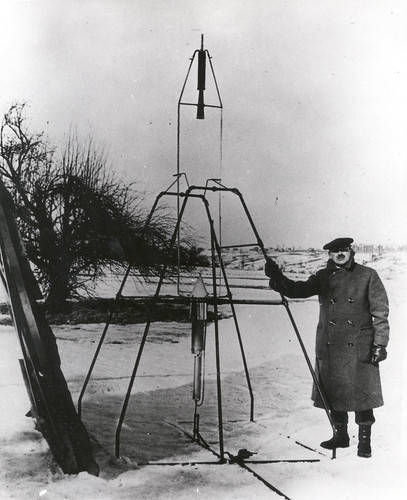
Posted by NASA on The Commons Dr. Robert H. Goddard and a liquid oxygen-gasoline rocket in the frame from which it was fired on March 16, 1926, at Auburn, Massachusetts. From 1930 to 1941, Dr. Goddard made substantial progress in the development of progressively larger rockets, which attained altitudes of 2400 meters, and refined his…
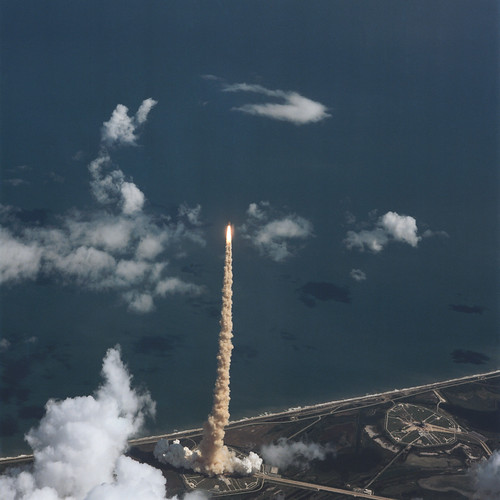
Posted by NASA on The Commons Atlantis, Orbiter Vehicle 104, lifts off from Kennedy Space Center Launch Complex Pad 39B at 12:53:39:983 pm (EDT). This aerial view shows OV-104, its external tank, and two solid rocket boosters rising high above LC Pad 39B atop a plume of exhaust smoke. Image Number: s34-s-026 Date: October 18,…
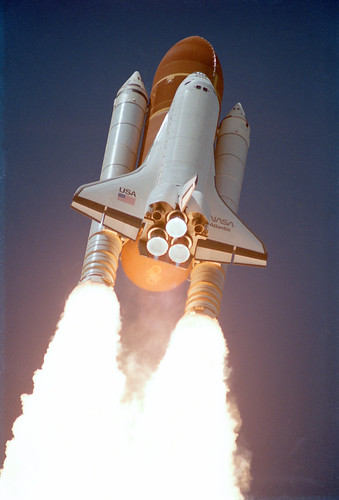
Posted by NASA on The Commons Liftoff of first flight of Atlantis and the STS 51-J mission. The view is from the below the orbiter and show its solid rocket boosters firing. Image #: 51j-s-003 Date: October 3, 1985 Tags: Launch, STS Source
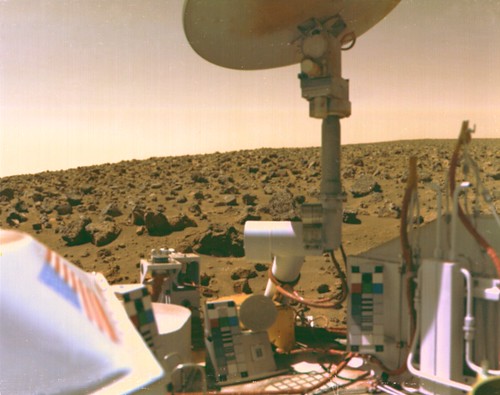
Posted by NASA on The Commons Description: The boulder-strewn field of red rocks reaches to the horizon nearly two miles from Viking 2 on Mars' Utopian Plain. Scientists believe the colors of the Martian surface and sky in this photo represent their true colors. Fine particles of red dust have settled on spacecraft surfaces. The…
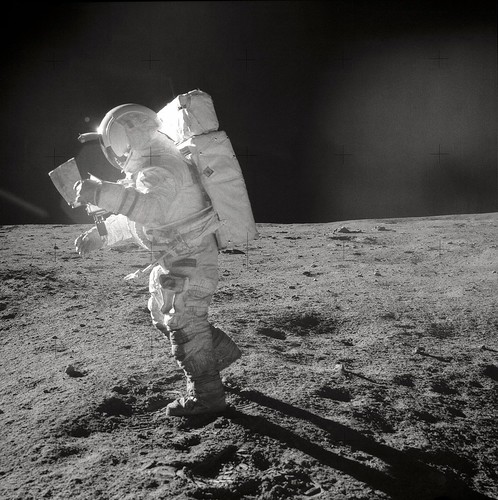
Posted by NASA on The Commons Description: Astronaut Edgar D. Mitchell, Apollo 14 Lunar Module pilot, moves across the lunar surface as he looks over a traverse map during extravehicular activity (EVA). Lunar dust can be seen clinging to the boots and legs of the space suit. Image #: Date: February 6, 1971 Tags: NASA,…
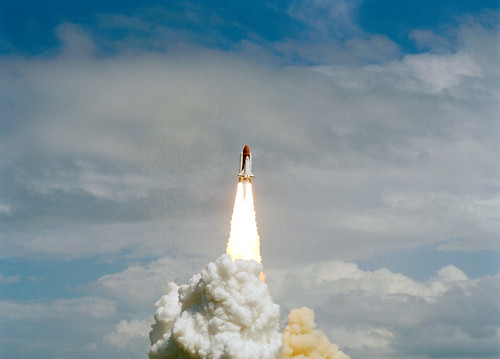
Posted by NASA on The Commons STS-26 Discovery, Orbiter Vehicle (OV) 103, rises into a cloudy sky and heads for Earth orbit atop the external tank (ET) as exhaust plumes billow from the two solid rocket boosters (SRBs) during liftoff from Kennedy Space Center (KSC) Launch Complex (LC) pad 39B. STS-26 marks OV-103's first flight…
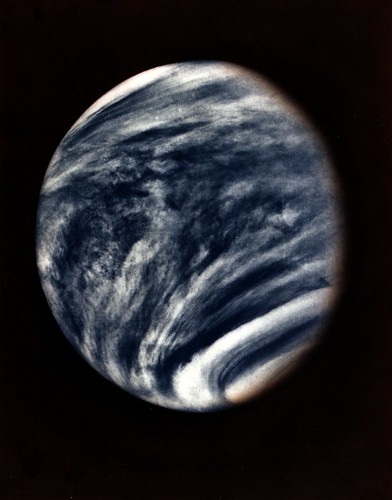
Posted by NASA on The Commons Description This picture of Venus was captured by the Mariner 10 spacecraft during its approach to the planet in early 1974. Taken with the spacecraft's imaging system using an ultraviolet filter, the picture has been color enhanced to simulate Venus's natural color as the human eye would see it.…